Monday, 3 March 2014

A Further Guide to Osprey-Related Ilnesses


I've never been entirely happy with the word “ospreyitis”. In strict biological terms, this would have to mean “painful, inflamed and swollen ospreys” - not only very unpleasant in itself but almost certainly a contravention of the Wildlife & Countryside Act as well. However, the name has stuck so, for what little it's worth, here is the WlW guide to osprey-related conditions, their etiology, causes and treatments...


Ospreyitis:  
A seasonal disorder characterised by the patient identifying any flying creature, from a hawk-moth to a harpy eagle, as an osprey. May be transmitted from one person to another. There is no known treatment.

Folie Haliaetus: 

A neuropsychiatric condition whereby people in bird hides feel compelled to start talking complete nonsense whenever the subject of ospreys is mentioned. Typical symptoms include “An osprey cannot let go of a fish after it's caught one, so could get pulled under and drowned.” “Osprey eyesight is ten times better than a human's.” “All ospreys migrate at the same time, following each other so they know where to go.” (etc). Symptoms may be alleviated by poking the patient in the eye with a sharpened stick or equivalent.

Pandiomnia: 

Pathological sleep-deprivation caused by worrying about what ospreys are going to do next. (Trample on their eggs... fall out of the nest... get wet... etc.) Most acute during the breeding season but can occur at any time. Medication is ineffective, but the symptoms may be alleviated by striking the patient over the head with a blunt instrument.

Corns Dyfi: 

A painful affliction of the feet caused by walking around Welsh marshland looking for ospreys.

Bassenthwaiste: 
An inexplicable enlargement of the nether regions and buttocks caused by sitting immobile in front of a computer monitor for five months. Treatment: android tablets.

Rutland Water:
 

An uncomfortable and potentially dangerous distension of the bladder and/or urethra. Caused by the patient's unwillingness to go the the lavatory in case he/she misses anything interesting on the nestcams. Treatment: plastic bucket or unused soup tureen.

Monday, 3 February 2014

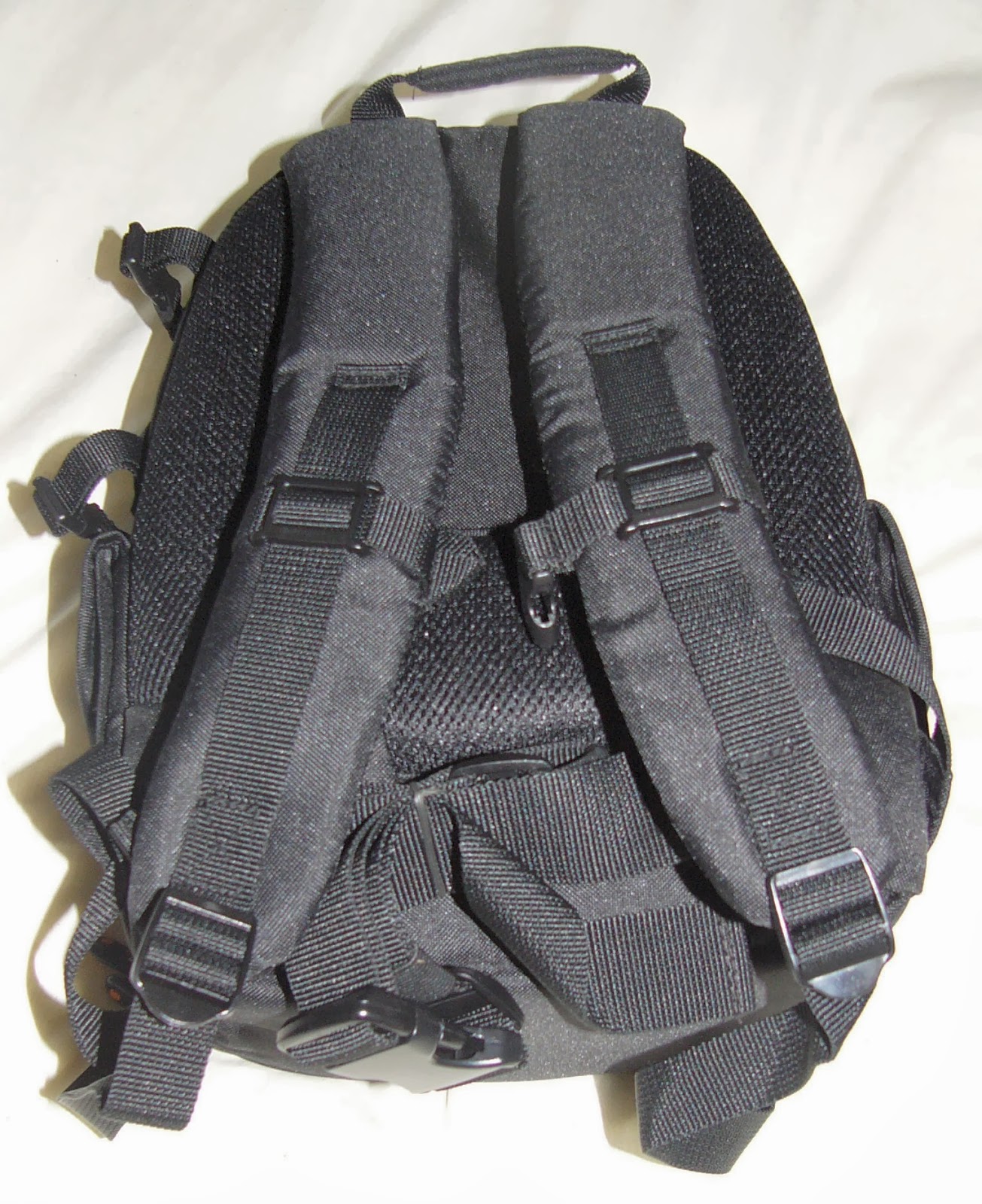
REVIEW: Amazon 'Basics' backpack for SLR cameras

I've always had a hankering for one of these backpack-style camera bags, but have been put off by the outrageous price of those on offer by the 'big name' accessory manufacturers.

This problem has disappeared recently, since Amazon released a selection of gear bags under their generic “Basics” label. This one is the medium-sized version retailing at STG £21.49 incl VAT and free delivery which - in this case – was ordered on Thursday evening and arrived first thing Monday morning.

Predictably enough, the bag is made of ballistic nylon and polyester in an unrelieved black both inside and out, apart from some snazzy zip-pulls with Amazon logos in orange. This anonymity is one of the product's big (but unadvertised) selling points: The conspicuous branding of bags by the likes of Canon, Nikon, Lowepro or Hama is the equivalent of attaching a sign that says “Please steal this bag, it has lots of expensive stuff in it.”

There is no indication as to country of manufacture. (That'll be China, then.) The stitching and other assembly is of good quality, though not outstanding, and the weight (empty) is commendably light at just a tad over 800g.

Inside is a single main compartment measuring 360 x 300 x 135 mm. This is enough space for two SLR camera bodies and a selection of lenses. The central portion will carry a camera with 300mm lens in situ – something my present everyday carry bag won't accommodate. Velcro dividers enable the layout to be tailored as you need it – in my arrangement, I was able to fit my 20x60 spotting scope in there as well. The interior is lined but the zips have no protection, so this backpack would be showerproof but probably not fully waterproof without a rain cover.

Inside the lid are two zipped pockets, also lined, with - joy of joys - transparent facings so that small items can be easily located within them. Lowepro take note. Exterior to the lid are two more divisions: the inner one is not quite deep enough for a laptop but an iPad or similar-sized tablet would certainly fit, perhaps with a bit of extra foam padding for peace of mind. There are two side pockets (with flaps) for odds and ends, and straps on one side that might secure a tripod - if it was a small and light one.

The rigging is good: ventilated mesh at back and padded shoulder straps. A narrow strap with Fastex clip is attached to these but its purpose is not entirely clear: it is too short to be used as a chest strap unless your chest is a lot smaller than mine. 

Further down, I was pleased to find hip pads and a nice broad waist strap – useful for belt-carrying of binoculars, GPS pouch or other accessories which would then stay with the bag when taken off.

All in all, the “Amazon Basics backpack for SLR Cameras” does (almost) everything that its pricier competitors will do – and for far less cash up front. Good value, but not for heavy use in the Amazon. (Or any other rainforest.)

Wednesday, 20 November 2013

THE CURIOUS CASE OF CAPTAIN LIZ


Some things are easier than others. Getting your local Renault dealer to only charge for servicing work that they've actually done is quite easy. Climbing Mount Everest is fairly easy.

Telling one of the world's most eminent ornithologists that he has made a series of mistakes in his data analysis is far from easy. Fortunately, Rob Bierregaard was very good about this, and we have been able to sort out the known facts of this rather sad story, and draw certain conclusions from it all.

Osprey Cap'n Liz left her natal area at Cape Cod on the 8th of October. As many juvenile ospreys do, she headed directly south, over the ocean and down the eastern seaboard of the USA. With the wind in her favour, the little bird made excellent progress – no doubt thinking that this whole migration deal was a piece of cake and that far too much was being made of it. Rather than turn west to make a landfall in the Carolinas, Liz continued on her southward track, at which point things started to go wrong...

The winds that had been helping her died down to almost flat calm for three days – an unusual bit of weather for that area at that time of year. Suddenly, Liz found that maintaining speed was much harder work than it had been. More wing-flapping was needed and she was using up her “fuel” reserves at an alarming rate. By the evening of the 10th, with no change in the conditions, Liz would have been almost exhausted. She even tried to retrace her course, turning back north, but by that time it was far, far too late. 

Thirty nautical miles away, the oceanographic vessel Atlantic Explorer was steering ENE towards her home port in Bermuda. Some days earlier, an osprey had landed on the ship and had kept company with her for a while. Rob Bierregarrd's team thought that this bird MUST be Cap'n Liz.

It wasn't. My analysis of the ship's daily positions shows that Liz never came to Atlantic Explorer, although at one point they were only twenty miles apart. Flying northwards in the darkness, Liz would not have seen the ship and their courses diverged rapidly. What happened next is a matter of some speculation: at 13:00 hrs on the 11th, Liz came down to sea level and her speed dropped almost to zero. She could not fly any further.


It seems certain that Liz had landed on some kind of floating item, although of course we don't know what this was. To the science team back in New Hampshire, the GPS track looked like the course of some powered vessel but it wasn't. I was able to demonstrate that ocean currents and tides would produce the same pattern effect, all on their own.

The PTT tracker continued to transmit but, stranded alone on her raft – whatever it was – exposed to a blazing sun and with no source of fresh water, Liz would not have survived for very long. Dehydration is lethal to birds, almost every time.

Liz was unlucky. Many other juvenile birds – not just ospreys – take this trans-ocean route to the Carribbean and Central America and the vast majority of them survive the attempt. Taking this path saves both time and energy, provided that the wind and weather do not turn against them. To us, this seems like gratuitous risk-taking but that's what birds do.


And they always will.

---------------------------------------------------------------------------------------------

Additional edit: 20 Nov 2013...

There is an intriguing postscript to this story which came to my notice after the above article had been finished.  Of course we don't know what it was that the osprey was cast away on during her final days, but there are more things floating about in the the empty corners of the ocean than coconuts...

Wolfhound adrift in April 2012. (Charles Page)
In February 2013, the Irish-registered 48ft sailing sloop Wolfhound was abandoned by her crew to the west of Bermuda after she got into difficulties during an offshore race.  All personnel were rescued, but Wolfhound continued to drift around the area.  She was seen in April by a passing vessel and found again in July by Matt Rutherford and Nikki Trenholm on their schooner Ault. Rutherford attempted to take Wolfhound in tow but, after an almost-unbelieveable series of misadventures that are detailed HERE, was forced to give up and cast her adrift again.

As far as anyone knows, the yacht Wolfhound is still adrift somewhere in the same area that "Cap'n Liz" was lost.  Could it be...?  We may never know.


Sunday, 29 September 2013

Home for the Winter


 I'm only human. I can easily become enamoured of pretty things, new things, unexpected or wonderful things - Ospreys and eagles and all the endless variety of birds. But first love endures, and these are mine...

The brent geese of Strangford Lough are back.


This morning I was up and out at stupid o'clock, driving the 20-odd miles to an isolated parking spot near the market town of Comber. It was still almost dark, and autumnly cold. A chill east wind whipped in off the slate-grey water, bating the full tide. Not a bird to be seen, on it or by it - they have more sense. But this is Northern Ireland – if you don't like the weather, wait fifteen minutes.

In fact it took twenty for the daily miracle to happen: the sun rose over Greyabbey – well named the place, so it is – and with that a flurry of charcoal wings, low and fast out of the indistinct horizon, and that unforgettable sound...


Of all geese, the brents have the sweetest voices. The new arrivals call to those already paddling in from their hidden roosts back in the saltmarsh. Together they merge into rafts of birds, stem-to-stern and head-to-wind. Last week there were a few hundreds. Today there are thousands.


I've already got my camera coupled to a Televue Ranger 90mm astro refractor. I hate using it for this – focusing is a nightmare, there's no depth of field worth talking about, and the whole set-up is optically snail-like at f8 on a good day – but nothing else in my kit will reach out the 500m to where the geese are starting to feed.

The species is Branta bernicla “hrota” - the pale-bellied race that breeds in the high Canadian Arctic, further north than any other of its kind. They have migrated almost 3000 miles by way of Greenland and then Iceland to spend the winter here in Ulster. It's estimated that 95% of the entire population returns to Strangford and Lough Foyle – a conservation challenge of epic proportions, for the dwarf eel-grass zostera noltii that they prefer grows almost nowhere else in any quantity, except - happy coincidence - the estuary of Afon Dyfi in Wales.

The tide is racing out now, exposing more than 40 hectares of mud flats. The geese follow it and so must I, round the shoreline to Castle Espie WWT where there are higher viewing points – and also hot coffee to be had. The mug goes down well and there's a chance to chat with the staff.

 What's the overall count on the Lough?

22,700 brent geese as of Friday – a good total with the peak month of October not yet reached. It looks like the birds have had a productive breeding season, unlike last year when numbers were down on average.

A few more shots from the shore hide. Curlew are in massed ranks at the edge of the saltmarsh, waiting for their particular cafeteria to open. A leavening of shelduck and wigeon have joined the geese, taking advantage of their vigilance. The sun is almost overhead now and it could even be called warm (with a little imagination).

Sunday afternoon visitors are pouring into the WWT centre, whooping and hollering, and I take the long route round the south perimeter of the reserve to avoid them, pausing only to wince at the recently-completed “Limekiln Observatory”: a well-intentioned but horribly misguided design that merges with the shoreline landscape like a fart in a diving suit.

But not even duff architecture can spoil this day: the geese are back and that's all that matters.


Links:

Ulster Wildlife Trust - Strangford Lough Campaign

Irish Brent Goose Research Group (Site)

Wildfowl & Wetlands Trust - Castle Espie

Saturday, 14 September 2013

Skyscanner

The weather-awareness of migrating birds


Giovanni Vitali (1876-1963)
Giovanni Vitali was a brilliant scientist but his timing was terrible.  In 1911, he had announced the discovery of a new sensory structure in birds – one that he named the “organ of flight”, although we now call it the Paratympanic Organ, or PTO for short.  The original theory was that this PTO was involved with directional control and balance – but why birds would need a second balance sensor when they already had a perfectly good one (in the inner ear) remained a puzzle.  Nonetheless, Vitali's findings caused a sensation at the time, with many follow-up papers and nominations for the Nobel prize flying around even faster than the birds he was studying.  But even then, things were changing... in a few short years, war would stalk across the face of Europe and the mainly Italian and German science journals in which Vitali's work was published fell silent, some of them never to reappear.

During the middle part of the 20th century, the strange story of the “organ of flight” passed quietly into the annals of Science and was almost forgotten.  Almost - but not quite...

Satellite tracking of bird migration has answered many questions – but it has also raised new and unexpected ones.  The latest generation of tracking equipment gives very good positional accuracy and can return data at hourly intervals.  This high-resolution data has shown that birds – even young raptors on their first-ever migration – appear able to make choices about their routes to take advantage of tailwinds and other favourable weather conditions.  More remarkably, they seem to be assessing the conditions several hundreds of kilometres down-range from a given position.   But how is this possible?

This chart shows the migration of osprey Blue YZ – a first-time migrant out of Loch of the Lowes in Scotland, being tracked by Scottish Wildlife Trust. On 6-09-13, YZ left the Isle of Man and flew south over the Welsh coast before veering south-west, and out to sea.   To all outward appearances, young YZ had made a terrible error of navigation and was now in danger of becoming lost.  But a study of the prevailing weather conditions at that time paints a completely different picture...

The plot (red line) shows YZ's course overlaid on a chart of wind speeds and direction. If the young bird had followed a “normal” course – east and south to the the mainland coast – it would have encountered adverse headwinds in the English channel and almost certainly would have had to pause its journey at that point.  But the course actually selected took YZ along the edge of an incoming weather front, with strong tailwinds at an altitude of around 300m which eventually brought it safely back over land in northern France.  By doing this, the bird saved at least one whole day's flying time – and a heap of energy into the bargain.  With the weather still in its favour, YZ continued on over the Bay of Biscay, repeating the same trick again during the following afternoon.

This is NOT an isolated example: every season, we see young migrants doing this kind of thing and there can no longer be much doubt that it is an innate “programmed” behaviour for them.

But how can a young and inexperienced creature obtain and correctly interpret something as notoriously complicated as European autumn weather patterns? One possible way is by looking at high-level cloud formations.

Alto-cumulus clouds ahead of an incoming warm front. (NOAA image library)

These patterns in the sky often presage the arrival of weather systems from the Atlantic Ocean.   They form at a height of between 5000 and 9000 metres – which means that they are visible from considerable distances.  A bird flying at (say) 300m ASL can command a view of the sky for two hundred kilometres in any direction.   What does that mean? On the next chart, I have plotted circles of 200 km radius and centred them on some typical migration “hot spots”.  


In each case, you can see that the “dangerous” sea crossings are in fact well covered by this range: a bird on the Solway Firth can get a view of weather systems well down in the Irish Sea; a bird at Portland Bill in Dorset commands weather info right over to the far side of the English Channel.

That explains some of the weather-awareness that birds seem to posses, (given thirty-odd million years of evolution, of course) but on its own it is not enough. To do everything they seem able to achieve, something else is needed. Remember Prof. Vitali's “paratympanic organ”?   Let's take a closer look at it...

On microscopic examination, the cells comprising the PTO look oddly familiar to today's anatomists.   In fact, they resemble the sensory cells found in the lateral lines of some fish species.  If that is so, and if the PTO isn't an organ of balance, then it might be something that senses pressure.

Barometric air pressure.

And – although conclusive proof still waits on some ongoing research – many scientists are becoming convinced that THIS is the missing piece of the puzzle.[2]  Satellite tracking has shown that long-distance migrants can maintain a constant altitude, even when flying over sea AND in total darkness.  They are able to do this within a few tens of metres – at least as accurate as the instruments set up to measure this performance. Without visual cues, the only way this could be possible is if birds have a built-in “altimeter” - and the PTO as air pressure sensor fits the bill perfectly.

And if THAT is true, then we can also credit birds with a real method for doing something that we humans have believed them capable of for thousands of years – sensing the weather in advance.

It doesn't have to be very sophisticated: here in western Europe, the general principle is that LOW or falling atmospheric pressure means changeable weather, with stronger south-west winds. HIGH or rising pressure generally means stable conditions, more northerly and lighter winds.

And for a young bird on its first epic journey south – that may be all it needs to know.

-Wlw

  • [1] Image 1 - Background: sunset over the Sine Saloum Delta. Photo: John Wright, used by permission.
  • [2] The Paratympanic Organ: A Barometer and Altimeter in the Middle Ear of Birds?  C.S. von Bartheld & F. Gianessi, Exp Zool B Mol Dev Evol. 2011 September 15; 316(6): 402–408.
  • [3] Scottish Wildlife Trust Website:  Loch of the Lowes
  • [4] Vitali is not to be confused with the notorious Mafia don Giovanni "Big John" Vitale, boss of the Detroit crime syndicate in the 1920's - who was never at any time nominated for the Nobel Prize.

Saturday, 17 August 2013

Not Small, Possibly Far Away


Head movements and range-to-target...


Both osprey youngsters are almost fully grown and taking a keen interest in the various things to be seen around their nest. This is not idle curiosity – in a few days (weather permitting) they will be obliged to avoid some of these structures while in flight, and perhaps land and perch on others.

They need to get a good appreciation of the size and position of all such things, and how to apply Dougal's Rule to them (“These are small, but the ones out there are far away”), otherwise known as perspective.

You will often see ospreys moving their heads from side to side when they are studying an object at medium range. They do this in order to get a better estimate of distance and size. Like almost all birds of prey, ospreys have binocular vision (two eyes working in unison for forward vision) but the difference in perceived position of objects (parallax) is not very great – the effective range for parallax alone is only about two metres, whereas we can use the same method out to almost three metres because our eyes are further apart.

Something else is needed.

Doing the head-wiggle gives additional scope to this method of judging distance, known technically as “qualitative stereopsis.” It includes the picking up of many different visual cues, including shadows and colour-based edge detection.

To land on a perch, or to avoid objects at speed, birds need to integrate all this visual information very rapidly. It has recently been discovered that structures in the optic nerves of birds contribute to this “image processing”, without all the work having to be done in the visual centres of their brains.


Tuesday, 23 July 2013

Integrating the Impossible

The complexities of resource exploitation in a littoral ecosystem

Estuary of Afon Dyfi looking south-west.
(Picture E. Evans, used by permission)

It's not the Amazon rainforest, despite all the rain. It's certainly not the high Serengeti under Ol Doinyo Lengai.  And yet these estuaries around the British coast are some of the most biologically productive ecosystems anywhere on the planet.  Each cubic metre of glorious glutinous silt down there contains over 25000 kJ of calorific energy – about the same as a dozen (large) bars of chocolate.  Fish base their entire life cycles around these places.   Wading birds flock to them in winter because there's no food resource that compares.

The Dyfi estuary supports not just one food chain but hundreds.  At the bottom of each are microscopic organisms living in the mud and, near the top, one osprey nest.   It seems like a perfect location for ospreys to live and breed, so why only one nest so far?  That's an interesting question – but first, a shaggy dog story...

 
This is Polky, a good-natured little pooch who lives with one of my neighbours across the road. Polky and his almost-identical brother Cobblers (don't ask) go for walkies twice a day, and their favourite game is catching a thrown tennis ball on the grassy area between our respective apartments.  To be honest, this is the only time I can tell the two dogs apart because Cobblers is brilliant at catch ball. He makes it look easy and he never misses.  Polky, on the other hand, cannot catch ball for toffee. His eyesight is fine, his technique is sound and his timing appears to be good. He really tries but he just sucks at it.  If the ball hits him on the nose and rolls away, that's a good effort by Polky's standards. Both dogs have been playing this game since they were pups.  It's a game of skill and co-ordination; one that involves instinctive AND acquired abilities.

Some animals are better at learning how to do stuff than others.

In Britain, many osprey nests are close to reservoirs or freshwater lakes. Catching fish in such places is by no means easy, but at least the birds know where the fish are.  Given the innate hunting skills they were born with, any reasonably competent male osprey ought to be able to produce fish for his nest.   However, rivers and their estuaries are different.  The overall food resource there is greater and more varied, but accessing it can be much more complicated.   In a tidal estuary and river, the behaviour and distribution of fish changes on an hour-by-hour basis, AND varies over seasonal time scales as well.   Weather patterns far upstream can change the salinity of the seawater offshore, or affect its temperature and transparency.  At any given spot, there may be dozens of sizeable fish present on one day, and not a single one at the same time on the next.

In such a complex environment, instinctive hunting skills are not enough – not by a long chalk. There is no inherited information that says..

“Flounders can be caught along the sandy areas south of the estuary, for an hour either side of low tide.”

“Hunting migratory sea bass in mid-May is a waste of time because there aren't any.”

“If visibility is poor today, there's a well-stocked trout lake about 12 kilometers north-east from here."

“If it's been sunny for three days, shoaling mullet will be taking plankton near the surface in the mornings.”


All this, and much else, has to be learned.  The reason that Monty - and his neighbour at the Glaslyn nest to the north - are so successful is that they have achieved a complete mastery of all these factors.  They know and understand the dynamics of foraging on the Dyfi, or Tremadog Bay, and it has taken them years to amass all the detailed information needed to do this.


Other male ospreys may not be so proficient, because it's one thing to catch sufficient food to feed yourself – quite another to collect enough for a female and a brood of ravenous youngsters as well.

The nest-provisioning stats collected in Wales illustrate this problem.  A solo osprey only needs about 400g of fish per day to maintain condition.  That's two small trout or one very moderate mullet.  This graph shows the weekly take required when three chicks are being supported.   And it's not just about quantity: if conditions are unfavourable, the solo osprey might go hungry for a couple of days until fishing becomes easier.   This state of affairs won't do when there are young to be fed – the incumbent male has to be able to produce something every day, and only a bird that knows his home range like the back of his own talon can do this.

Unringed osprey "Dai Two-Dots" 26/8/12  ( (c) Dyfi Osprey Project)


Perhaps this is the real reason that “Dai Dot” and other satellite males have not attracted roving females and set up nests of their own in west Wales.   They can live along the estuaries in the summer quite comfortably, but they have never acquired the EXTRA skills and knowledge to be successful providers for a family.

Like Polky, they just don't have what it takes to catch the ball.