Tuesday, 23 December 2014

Sebkhets of the Sahara

Geography Lessons from Ospreys #438

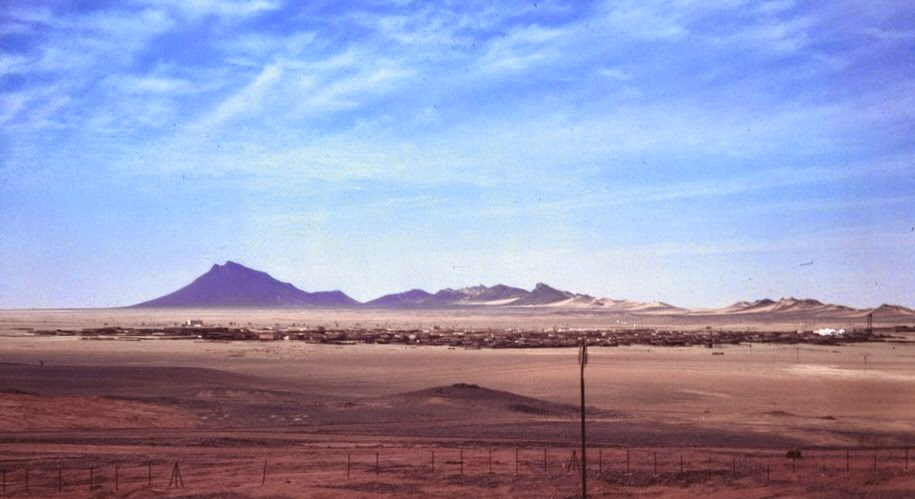
Location: Assouerd Province, Western Sahara

Dama Gazelles (Image: W.A.Z.A. Conservation)
The western coastal margin of the Sahara Desert is a region with almost no rainfall. To our eyes, it appears desolate and lifeless – and yet there IS wildlife here.

Among the dunes and wind-scoured rocky plains, isolated pockets of hardy vegetation grow, flower and set seed. The seeds attract sand grouse and roving bands of migrant finches. Dainty gazelles known as “Mhorro” (Nanger dama mhorr) which are critically endangered elsewhere in the Sahel, still graze there, and the almost-mythical white antelopes (Addax nasomaculatus) - one of the rarest hoofed animals in the world and until recently thought to be extinct in the wild, are also to be found... if you know where to look.


The reason for all this is the presence of sebkhets.

A sebkhet is (in this context) a low-lying area where groundwater from aquifers below the desert seeps to the surface. They can be brackish or can contain fresh water, depending on the local geology. The mendicant camel-drivers have always known about them and some of the larger, more permanent ones have Arabic names. Others are smaller: they can last for only a few years or even months, before the desert wind covers them with sand again and exposes some other sebkhet elsewhere.

Addax nasomaculatus (Image: wildaddax.org)
Ground-reflectance images from satellites, together with LIDAR measurements, have enabled scientists to map the distribution and extent of the desert sebkhets. There are many more of these features than was originally thought, and it is now clear that they are the secret of how large grazing mammals have been able to survive in a place where none should be. At the Parc National de Safia, a closed reserve as been established where the Mhorro and Addax are protected. Their numbers and gene pool have been bolstered with captive-bred animals from European zoos, and the last count was up 23% overall since the project started.

In UV's area, there is a permanent sebkhet and several small un-named ones. Perhaps it isn't such a dull place for an osprey after all!


[Sources:]

Directory of African Wetlands, R. H. Hughes, J. S. Hughes, G. M. Bernacsek
Antelopes: West and Central Africa – action plan, R. East, ed. (WWF)

Sunday, 21 December 2014

Review: "Ospreys in Wales" by Emyr Evans

This is not your average bird book. Ospreys in Wales – the First Ten Years by Emyr Evans recounts a remarkable conservation success story – but it is far more than that. At its very core, this is a book about faith and inspiration, and about how the combination of these rather abstract concepts brought about the re-establishment in Wales of these rare and charismatic birds of prey.

It is at once a history, a memoir - and a thriller, with all the attributes required: excitement, jeopardy, sex and violence, rivalry, betrayal, tragedy - and flounders. (Though not necessarily in that order.) After an erudite - and lavishly illustrated - introduction has set the scene, Evans expands and develops the story. He writes in an easy, conversational style that seamlessly draws the various locations and events together. Eventually the birds themselves take centre stage, as larger-than-life characters in their own dynastic saga – the englynion of ospreys.

There is plenty here to delight the enthusiast, but the casual reader too is in safe hands. Evans successfully avoids the twin pitfalls of anthropomorphism on the one hand, and dry ascetics on the other. Instead, we are treated to a narrative that carries us along into the fascinating world of ospreys. Details and anecdotes abound, to be sure, but they are presented lightly and with the author's own passion for his subject shining through. Nor is his sense of humour (familiar to all of us who know him) absent, though here it is suitably reined in.

Emyr Evans is a behavioural ecologist by training, but he is also a photographer of rare skill with a sure eye for composition and effect. Ospreys in Wales would be significant for its text alone but the crowning glory of this hardback edition is the stunning collection of colour plates that adorn and inform every page. Drawing on his own library - as well as contributions from professional Andy Rouse and others - Evans shows us why tens of thousands of people around the world now follow every move that these birds make.

This is a true expert's story, expertly and compellingly told. Highly recommended.

"Ospreys in Wales - the First Ten Years" E. Evans (2014) ISBN: 0993099009

Amazon: http://www.amazon.co.uk/Ospreys-Wales-First-Ten-Years/dp/0993099009

Website: http://www.ospreysinwales.com/

Sunday, 14 December 2014

Ghost Town

Geography lessons from Ospreys #437
Location: “Puntillas de las Raimas”, Cintra, Western Sahara, N 23.08, W 16.20

Kielder osprey “Blue UV” arrived at the Gulf of Cintra on 11th December 2014 after an epic 2000 km migration flight from his long stopover in southern Portugal. We were intrigued – few if any tracked birds have ever visited this remote and disputed spot on the edge of the Sahara Desert. As UV looked around his new discovery, I did the same thing on Google Earth. I knew almost nothing about it. Were there any signs of human habitation around the place? There were not.

But there used to be...


Separated in time by nine years, these two aerial photographs of the same location show that there was once a thriving fishing community here at Las Raimas.  Now the hundreds of boats - rough-built inshore craft known as piroques - are gone, and the shanty town that housed their owners and crews is almost buried under the shifting coastal sand dunes. The bay is in a prime position for fishing (and for migrating ospreys) located as it is in the middle of one of the most productive continental shelves on the entire planet. The lee side of the bay is an ideal haul-out for these shallow-draft boats as it is sheltered from the prevailing northerly winds and the powerful Atlantic surf. So what caused these people to abandon their village during this period?

It could have been the local security situation: Western Sahara (formerly Spanish Sahara) has seen sporadic armed conflict for years, victim to the rivalries of its more powerful neighbours: Morocco, Mauritania and Algeria. All of them have coveted its natural resources, but none of them have done its people much good.

Perhaps it was the encroachment of the desert itself, or a failure of the (never reliable) water supply, or the attractions of a less-hazardous way of life in some other line of work. But I don't think it was any of these factors...

The German-registered super trawler "Maartje Theadora" operating off the
coast of Mauritania, 2013. (Greenpeace)


In recent years, the traditional artisan fishing industry in west Africa has been taking a hammering. Locally-owned fish processing stations have closed, boats have been laid up, whole coastal communities have been displaced. The hammering has been administered by large foreign factory trawlers from Europe, from Russia, and now from the Far East as well. Operating around the clock - and on a netting scale that the piroques cannot match - they can take out in one single day, more tonnage than all the fishermen of Cintra would have harvested in their entire season.

The big trawlers need nothing from the land, except fuel oil. They process and refrigerate their own catch, and do not need to sell it at local markets. They respect neither national agreements nor quotas, nor the boundaries of marine reserves. The discarded by-catch includes every creature that swims, and it all goes back over the side – dead. For the countries affected, it's an economic and environmental disaster. But down along the same coast, one man has had enough.

Haïdar el Ali is Senegal's pugnacious and mercurial Minister for Fisheries. Since moving from Environment - where last year he took on Big Timber with devastating effect – he has revoked 29 foreign operating licences, arrested and detained the Russian trawler Oleg Naydenov, and is personally overseeing regeneration projects among his country's artisan fishing communities. You can read more about his exploits HERE.

But what then for Las Raimas? Its people may have moved elsewhere, but they will have taken their disturbance and their pollution elsewhere, too. The lagoon at the north side of the bay - known as the Bajo Tortugo ('little tortoise', after the curiously-domed sandbar that guards its seaward entrance) is now clean and quiet. At least one osprey has come there instead for a visit. And he has come to a very remarkable place, because the Gulf of Cintra is not just blue ripples and an empty beach: its warm shallow waters are thought to be a nursery area for rare marine life and mammals, including Risso's dolphins and the critically-endangered Mediterranean monk seal. With suitable research and protected status, it could be as important to the eastern Atlantic ocean as the Sea of Cortez is to the Pacific.

 I didn't know any of this before UV arrived in the area, but I do now. He is doing a great job.

LINKS:

Forestry Commission England, Kielder osprey blog: https://kielderospreys.wordpress.com/
EU fisheries policy in West Africa (Oli Brown 2009) http://hdr.undp.org/sites/default/files/hdr2005_oli_brown_29.pdf
Biodiversity - Atlantic coastal desert: (WWF) http://www.worldwildlife.org/ecoregions/pa1304

Sunday, 7 December 2014

The Migration Merry-go-Round

Migration in Detail - (Part 3)

Way back in 1999, I knew even less about ospreys than I do now. But I did know some things about birds and I had completed my foundation course in Meteorology, so when the Rutland translocation project came to my attention, I – and many other enthusiasts – followed its progress with increasing fascination. Some of the translocated juveniles were fitted with tracking devices. In those days, the units were primitive and highly experimental: they used ARGOS doppler signalling to calculate the positional fixes (which we now know to be a less-than-ideal method.) The trackers were as unreliable and short-lived as a politician's election promises – and only marginally more accurate. But they worked.

When one of the birds, a male tagged as R03(1999), showed some unexpected course deviations over the Sahara Desert, I suggested that he was avoiding a formation of adverse weather systems (which I had detected on weather satellite images) that had developed to the south-west of his position, and that these might affect his ability to use soaring flight while over the desert. This suggestion was put to the Men Who Knew A Lot About Ospreys at the next group meeting. It was not favourably received.


“Ospreys on migration use thermals very little, if at all” was the conclusion of the MWKALAO, although they didn't offer any alternative theory to explain the bird's behaviour. Being a humble and uninformed amateur, I accepted this as being the expert view...

Until now

When the published track from Finnish osprey “Helena” came in for early October 2014, it seemed to show that here again was a bird using soaring techniques while over the desert.


Unlike the examples I produced for previous articles in this series, Helena's sample is not “slope soaring” or any other kind of terrain-following flight. There are no slopes at this point, no escarpments or ridges to provide an updraught. To me, these movements looked very like direct thermal altitude modification. But it was not quite conclusive. To be absolutely certain, I needed to get my hands on the actual data files for an osprey flying over Europe (where there are lots of GSM cell towers) so that the recorded level of detail was as high as could be possible with this new technology. 

Joanna Dailey, who volunteers with the Forestry Commission osprey conservation project at
Blue VV at nest Aug 2014. Blue UV in the background
(Image: Forestry Commission England)
Kielder Forest
, arranged for me to get authorised copies of their files for three juveniles. They were carrying GSM trackers and all were operating correctly. The hunt was on.


Two of Kielder's birds followed a mainly coastal and/or over-sea route for their migration. But the third, tagged as “Blue VV”, migrated over land and through central Spain. With light winds and hot sun in late summer, this is prime territory for the formation of thermals. Each day I had been carefully saving the weather charts for this region and these told me exactly when and where to look for the evidence. And little VV did not disappoint me.


Even position fixes at 70 seconds apart does not conclusively prove that spiralling flight has taken place – but adding in the direction of travel at each data point does. During this afternoon flight, there are eight other examples of the same behaviour, roughly at even time intervals.

So... were the Men Who Knew A Lot About Ospreys wrong, fifteen years ago? Well, not really, but they may have been misled by the early technology which - given the comparatively low number of cumulative fixes - seems to show birds flying in reassuringly straight lines across the broader landscape, when in fact they do nothing of the sort. As I have tried to show in this series, we are still learning things about the minutiae of bird migration...

… and there's a lot more yet to be discovered.

In the final part of this series, we will consider the physiology and layout of raptor wings, and see how evolution has adapted different species to have the appropriate “equipment” for their varying lifestyles.

Wildlifewriter acknowledges the use of tracking data supplied by the Natural History Museum of Finland (Luonnontieteellinen Keskusmuseo)and the Finnish Osprey Foundation, and data and images by Forestry Commission England.

Links:

Rutland Water Translocation History: http://www.ospreys.org.uk/osprey-facts/the-translocation-project/
Kielder Osprey Blog (Joanna Dailey): https://kielderospreys.wordpress.com/
Bird's Soaring flight (Technical): http://arxiv.org/ftp/arxiv/papers/1012/1012.0434.pdf

Saturday, 22 November 2014

Slope Soaring and Ridge Riding

Migration in Detail - (Part 2)


In the previous article in this series, we looked at one of the energy-saving flight modifications used by ospreys and other raptors during their migrations. Like human glider pilots, ospreys have developed a whole range of techniques that can be used - either singly or in combination – to gain maximum advantage from the prevailing conditions.

Using data from the latest GSM-type tracking units, which can log flight parameters at intervals of minutes - rather than hours, as was typical of the older UHF devices – we can get a much clearer view of what these birds are doing and how they are doing it...

In November 2014, adult male osprey “Tero” was flying south-west down the Arabian Peninsula. After a major diversion to avoid adverse weather south of Iraq, he had reached the Jabal Tuwayq - a long north-south escarpment that marks the eastern boundary of the Asir Highlands in Saudi Arabia. The winds were light but slightly against him. But Tero was able to use the overall rising air current caused by the gentle terrain gradient in a method known to pilots as “slope soaring”

 
As with the “crosswind tacking” technique, this allowed him to gain altitude by turning UP the slope, and then maintain course progress by flying down it at a shallower angle. The advantage of this system is that it works for almost any wind direction that is at a greater angle to the line of slope than 30 degrees.

"Blue 7H" (Image: Joanna Dailey)
A variant of this flight mode is what I've chosen to call “ridge riding”. It is an adaptation to more complex upland terrain where there are many changes of elevation, with steep-sided river valleys and hill crests. And the example chosen this time features “Blue 7H” - a female first-time migrant from nest #2 at Kielder Forest. Blue 7H provides the possible answer to a question that came up on one of the discussion groups, which (in summary) was:

“Do juvenile birds have the innate (instinctive) ability to use these energy-saving techniques, or do they have to learn them as adults?”


Only seven days after leaving her natal nest, 7H had reached the Galicia region of northwest Spain. Crossing this mountainous and forested landscape, she took advantage of local up-currents along the windward side of ridges to maintain the necessary height and made good progress southward and into Portugal. It seems like even a young bird of prey comes equipped with the full repertoire of flight, and only needs to add a modicum of practice. This confirms visual observations of other migratory species on their first migrations.

In the final part of this series, we will look at some other flight modes that are used by ospreys, and see how their anatomy and wing layout influences what they are able to do.


Wildlifewriter acknowledges the use of tracking data supplied by the Natural History Museum of Finland (Luonnontieteellinen Keskusmuseo)and the Finnish Osprey Foundation, and data and images by Forestry Commission England.

Links:


Monday, 10 November 2014

A Goldfish for Birgit

If I could, I would travel to Senegal, find “Birgit” the osprey, and hand her a halibut in person. And not just any halibut, but a halibut made of solid gold and inlaid with semi-precious stones.


Which she probably wouldn't like.
 
I don't actually have the money or the time (or indeed, a golden halibut) for such an extravagant gesture but the reward would not be unfitting. Not since the time of Ceulan himself has there been such an osprey for the getting of knowledge – and the stories of these two remarkable young birds intersect in a way that could not have fallen out better if I had dared to script it myself...

There are many scientific theories about how long-distance migratory birds achieve their point-to-point navigation. The current wisdom (such as it is) involves a synthesis of various sensory contributions and, over the years, several studies have suggested that birds can “see” the Earth's magnetic field in order to orient themselves. The results have been mixed (to say the least!) and often non-repeatable – which, in Science, is generally A Bad Thing.


The proponents of magnetic navigation have had to take their idea through several iterations: originally it was proposed that birds – and other animals – had some kind of “built-in compass” that told them which way was North. This ran into trouble quite quickly, when experiments showed that animals have no concept of “North” as a specific direction. The next version was that these creatures were obtaining positional information from lines of magnetic force. Unfortunately, this doesn't work very well either: in many places on its surface, the Earth's magnetic field lines lie parallel to each other, which would make them useless for point location.

To get round this problem, the next modification was that animals could sense the “inclination” of field lines – sometime referred to a the “dip angle” which changes with both latitude and longitude. This is certainly feasible (in theory) but even us humans need extremely sophisticated and accurate instruments to measure the dip variation - which is very small – and there was no known sensory apparatus in birds that would be capable of doing this. Meanwhile, researchers who actually know something about birds were studying data from tracking experiments and ring recoveries.[1] In Sweden, an important study looked for the characteristic direction shift that would be evidence of such a navigational mechanism. They did not find it.


The magnetophiles did not give up. Microscopic particles of iron oxide were found in birds' beaks, in the their eyes, their brains, and even in their feet! Weird quantum-mechanical effects were invoked [2] although with a convenient disregard for the actual laws of Quantum Physics. Some experiments were done which were so creative that no animals were involved in them at all. The debate continues and the jury is still out on this stuff.

So – at least as far as ospreys and other raptors are concerned – where does the evidence lie? Is this whole “magnetic navigation” thing the genuine banana, or just a load of haphazard hornswoggle? Can't the birds themselves help us out with this?

Oh yes...

[Click for larger]
 
When Ceulan made his epic migration in September 2012 he passed right over the Kediet al Jill – a 500m-high “guelb” or outcrop hill of magnetite iron ore in eastern Mauritania. This place is one of the most prominent and highly-localised magnetic anomalies anywhere on Earth so if Ceulan's navigational sense was ever going to be visibly affected by anything, this is the place where it would happen.


His course did not deviate by any appreciable amount. But THAT was only one example – until last week, when Birgit came to the same place. (4.11.2014) Not content with a simple pass-by demonstration, she roosted for the night on the north-west slope of the mountain itself. And in the morning, the time when all ospreys take their bearings and direction for the coming day's flight, she simply took off and headed straight towards her eventual wintering site in northern Senegal.
 

If ospreys really did use field lines as a primary navigation method, both of these birds would have been flying in circles around the Kediet until they got far enough away from it.  But there is no sign that it had any effect on their navigation whatsoever.


Magnetic beaks, my ass...


-Wlw.


Wildlifewriter acknowledges the use of tracking data supplied by Montgomeryshire Wildlife Trust, the Natural History Museum of Finland (Luonnontieteellinen Keskusmuseo) and the Finnish Osprey Foundation.


[1] “Satellite tracking of Swedish Ospreys Pandion haliaetus: autumn migration routes and orientation” Mikael Hake, Nils Kjellén and Thomas Alerstam, JOURNAL OF AVIAN BIOLOGY 32: 47 – 56. Copenhagen 2001


[2] “A biomagnetic sensory mechanism based on magnetic field modulated coherent electron spin motion.” Klaus Schulten, Charles E. Swenberg, and Albert Weller. Zeitschrift für Physikalische Chemie, NF111:1-5, 1978

Monday, 27 October 2014

Downwind Tacking

Migration in Detail - (Part 1)

Image 1 - Osprey "Seija" being fitted with her PTT tracking unit by Harri & Joona Koskinen near her home nest in Utsjoki, Finland.  Photo: Tero Niskanen. Used by permission, Osprey Foundation Sääksisäätiö, Finland


The new VO65 yacht has a high aspect-
ratio sail plan, suitable for trans-ocean
endurance racing
On the 11th October, the competitors in the 2014/15 Volvo Ocean Race departed Alicante on the first leg of their 70,000km round-the world voyage. They left the Mediterranean and, three days later as they were heading down the coast of Morocco, the wind was directly behind them. This was no good at all, and something had to be done.

The class of sailing boats being used – the Volvo Ocean 65 – is no luxury cruising yacht. They are cramped, noisy, uncomfortable, wet, overpowered and undermanned – and ridiculously fast. Despite being over 20m long, the VO65 weighs less than 13 tonnes. It is constructed from carbon fibre and other lightweight composite materials. The sails are not made from sewn cloth panels in the traditional way: instead, they are vacuum formed from high-modulus fabrics such as Kevlar on an enormous mould that creates an aerodynamic profile, like the wing of a bird. 

Migrating ospreys are in a kind of race, too. However, the rules for their contest have been set by Evolution and the winners are those birds who complete the set distance – not in the shortest time, but with the least expenditure of energy. In order to do this, migrant birds seem to have a number of strategies that they can choose from, depending on the conditions encountered along their routes. And one of these methods is very similar to a technique developed by the helmsmen of modern high-performance racing craft:- 

Downwind tacking.

 No sailing vessel can progress directly into the wind. Instead, they must steer a zig-zag course at angles of about 30 degrees to the wind direction, making several “tacks” - or changes of direction – to reach a given point. Sailing directly AWAY from the wind is much easier but, for these racing machines, it is very inefficient because the boat can actually sail faster than the wind which propels it. The crews have worked out that they can achieve a lower point-to-point elapsed time (the velocity made good, or “VMG” for short) by sailing at maximum speed, again at an angle to the wind. They cover a greater distance, but the overall time taken taken to do so is improved.

Millions of years ago, migratory birds discovered the same trick BUT, instead of optimising speed (VMG), they adapt to the conditions and achieve maximum distance per unit of energy expended. Unlike the yachtsmen, birds find that a crosswind has a BAD effect on their flight efficiency, and this is for two reasons: firstly because they have to make constant small course corrections to stay on track, and secondly because the airflow over their wings is disrupted, resulting in excess drag due to turbulence.

In autumn 2014, an adult female osprey named “Seija” was fitted with a GSM satellite tracker by researchers in northern Finland.[1] She migrated strongly down through Europe, crossed the Adriatic near the “heel” of Italy and skipped over the widest part of the Mediterranean in a single 14-hour hop. Rather than resting, Seija continued southwards during the next day before coming to roost at the edge of the Lybian desert. She had flown 5300 km in only thirty days.

Next morning, Seija was up and flying early and within three days had reached the border between Algeria and Niger. How was she managing to cover these distances, across the wind? The chart below shows the details of one hour's flying time, and illustrates that these adult ospreys from Finland know a thing or two about crossing deserts...

[Click for larger]
So what is going on here? The figures in white are altitude (in metres) at each track point where there is a major direction change, and the points themselves are registered at intervals of about 80 seconds. There is no cloud cover. The land surface is about 600m and comprises flat stony desert terrain, with some low-growing scrub vegetation in patches. There are no large-scale thermals here, because the area is dominated by stable high pressure. However, small columns of rising air form locally in the surface layer, and these can be very numerous as the terrain is heated unevenly by direct sunlight. 

 Each time Seija encounters one of these, she turns downwind and uses it to gain height. Her rate of climb is around 200 metres per minute – probably achieved with little or no extra effort AND without wasting time on “classical” spiral soaring. Seija simply flies in the up-current while it lasts. As soon as she reaches the limit of the column, she turns back on her proper course, flying easily with occasional wing-flaps – not gliding, but gradually losing altitude to increase speed and conserve energy. Clever Seija is experienced at this migration stuff and she knows that her path will soon cross another up-current, where she can repeat the trick.

Adding up the figures for this part of her journey, I find that Seija had covered a much larger aggregate distance than a direct start-to-finish route, but in much the same time as she would have done without employing this technique. Meanwhile, back on the ocean, the VOR sailors had achieved overall average speeds of 8.7 knots in a wind that rarely blew over 10 knots. 

I bet they had to work a lot harder than Seija did.

 
So... does all this mean that ospreys never use soaring flight in thermals during migration? No, it doesn't – and in the next part of this article, we will take a look at a different bird in a different part of the desert, some other variants of long-distance bird flight, and see how an osprey's wing-shape is perfectly adapted for these purposes.


Wildlifewriter acknowledges the use of tracking data supplied by the Natural History Museum of Finland (Luonnontieteellinen Keskusmuseo) and the Finnish Osprey Foundation.

[1] Links:- 

Sääksisäätiö: http://www.saaksisaatio.fi/en/index.htm 

Volvo Ocean Race: http://www.volvooceanrace.com/en/home.html