Monday, 14 July 2014

A Difficult Matter

“The Naming of Cats is a difficult matter,
It isn't just one of your holiday games...”

If T.S.Eliot thought that cats were difficult, he must never have encountered the controversy that has surrounded the “naming” of wild birds whose lives are featured on the Internet.

(Image (c)2014 Montgomeryshire Wildlife Trust)

Few other topics polarize opinions on the forums and chatrooms in quite the way that this one does. In only a matter of hours, a simple discussion on which name is best will have degenerated into a wholesale slanging match and eventually end with each faction branding the other as “Nazis” in the traditional Facebook fashion. But is it REALLY such a big issue...?

Part of the problem seems to originate with those people who think that giving names to wild creatures is in some way “unscientific” or even “disrespectful.” I question their motivations about this. Many of the top osprey researchers around the world are quite comfortable with the concept, and yet their scientific credentials and integrity cannot be doubted. I suspect that the objections come from those who think that taking such a position will in some way make them look like “proper naturalists” - presumably this being easier than actually going to University for four years.

At the other end of the spectrum, and diametrically opposed, are those who regard the animals to be seen on TV series or live streaming as vicarious pets. For them, it is important to have names and the cuter and more whimsical the names are, the better. I understand this too – even though the idea of a chick that will later become a large predatory bird being called “Pootsie Fluffykins” (or similar) is a bit too whimsical, even for me.

In sober reality, though, the truth is that both of these artificially exaggerated stances are just wrong. The birds remain wild birds, and the allocation of names to them does not affect their lives in any way. They are not being disrespected, for they would not value our respect nor be troubled by the absence of it.

It does not matter if we choose to identify an individual bird by a name, or a leg ring (band) number, or a project database index code. All of these are just symbolic tags – a matter of human convenience - and the differences between them exist only in the eye of the beholder.

Friday, 13 June 2014

Getting Bigger, with an 'S'


"All that we can do, is to keep steadily in mind that each organic being is striving to increase at a geometrical ratio."
Charles Darwin.

Osprey chicks at approx 28 days from hatch
[(c) BGGW Project 2014]
What do hurricanes, the Greek alphabet, share movements on the Stock Market, the war in Afghanistan and old movies have to do with growing osprey chicks? Okay – I know that most of the people who read this blog are smart, so you're probably way ahead of me already.

This is another one of those “things”, right?

Yes, it is.

The thing in question is a graph, having a very specific shape – that of a letter “S”. The name “sigmoid curve” derives from the character Σ which is sigma in Greek. Of course it doesn't look anything like the shape of the graph but we will dismiss that minor detail with an airy wave and press on regardless...

An osprey egg is approximately the same size as a standard domestic hen's egg. Osprey chicks are born small and have to grow fast. Very fast. But their RATE of growth is not a constant. They start to develop slowly but, as time passes, the speed of growth accelerates until it hits a maximum at about 20 days – at which point, something interesting happens.

Female ospreys (and most other female birds of prey) are larger than adult males. But this size difference – technically knows as
sexual dimorphism – is only implemented during the latter stages of the growth spurt during pre-fledge development. A version of the graph (thanks to University of Montana Geosciences) shows this clearly. [1]


General graph of weight / days from hatching, (as modified by E. Evans, MWT)

The sigmoid curve seems to be something that is very fundamental in natural processes. We can model it mathematically using a function called the logistic equation which has the typical form

Since it was first discovered by Belgian mathematician Pierre Verhulst in 1838 as a possible descriptor for population growth, the logistic equation and its derivatives have been spotted all over the place. Hurricanes and other weather systems develop according to this pattern. The capacity of troops to sustain combat, the share price of a newly-floated company on the Stock Exchange, the relationship between foxes and rabbits as predator and prey... all can be found to fit the same behaviour.

In medicine, cancerous tumours show the sigmoid curve while growing – and this discovery means that mass screening and early diagnosis are critical in the successful treatment of such conditions. It has even been found that some non-biological chemical reactions work this way too, leading to methods of salvaging old film stock that has been deteriorating over time. 

But back to the ospreys...

Osprey chicks at 40 hours (left) and 4 days from hatch (right).
[(c) Montgomeryshore Wildlife Trust]
The fact that growth rates conform to this version of the sigmoid curve means that we can't tell (by size alone) if a chick is male or female, until they are older than about 30 days from hatching.  After that, it should become clearer.


Notes:

[1] The graph shown was drawn from data taken in North America, where the resident ospreys are a different sub-species. This version was modified by Emyr Evans (MWT) to more properly reflect the observed rates in European birds.

The plot itself is compressed along the horizontal axis for clarity. The actual curve would, of course, be much shallower than this.

Monday, 10 March 2014

Cheating the Winds

Cheating the winds

How to do Spring migration, bird-style...


Here in western Europe, the prevailing airstream in early spring is from north-east to south-west, except over the British Isles and NW France where incoming Atlantic systems can give local winds out of the west. In west Africa, the general pattern is much the same: high pressure over the Azores gives a more-or less constant anticyclonic (clockwise) rotation of the winds, keeping them flowing from north to south over coastal regions.


For birds returning north for their breeding season at this time of year, this presents a problem: head winds impede their progress and – if strong enough – could mean no progress at all. Fortunately, birds have a number of tactical ploys that they can use to lessen the adverse effects of this situation...

1) Wait for a window.

As part of the normal variations in weather, the prevailing winds can change. Periodic “equalization events” along the inter-tropical convergence zone can result in low pressure areas forming over the Sahara Desert and, coupled with this, a shift in position of the Azores High. For periods of several days, winds over the whole region swing round and give the birds more favourable conditions to gain ground.

2) Staging:

This is the tactic adopted by many larger migrants, including adult ospreys. On previous migrations, they have identified “refuelling stops” along their route, where food can be obtained and safe roosting sites found. Many individual birds use the same locations on every annual return journey, meaning that they can replenish flying energy and push forward on the next leg, even if winds are contrary.

3) Use the terrain:

Local geographical features can give favourable 
conditions, even when the prevailing winds are against. These include wind-shadow areas behind north-south hills and along coasts. “Wind funnels” can be formed at mountain passes (see diagram). A phenomenon called “adiabatic cooling” causes local air movements as a result of pressure differences down or across slopes. Birds seem to have an instinctive awareness of these processes and are often seen to exploit them.

4) Make an early start:

In maritime climate zones, the prevailing winds are often at their easiest just before and after dawn. A migrating bird can cover good distances at this time, perhaps resting instead during the later part of the day when the wind tends to be stronger.

5) Situational awareness:
"New Arrivals" by Martin Ridley

Many species of birds migrate in small flocks or extended family groups. It has been shown that skeins of geese keep an eye on the progress of other groups nearby, and will change altitude or direction if the birds ahead or to one side of their own group are getting a benefit.

6) Fly low, fly slow:

Unlike ourselves, birds have no concept of “average speeds” that have to be maintained during a flight. Their main flight parameter is energy usage, and this means that flying fast into a headwind makes no sense: it is not an energy-efficient way to travel. Keeping the speed down means that they get the same aerodynamic lift, and use the same amount of energy but cover less distance overall. This is not a problem in itself. It is better for a bird to arrive three days late at its destination than to be “on time” - but so knackered that it is unable to defend its breeding territory from others.

Wind speeds are generally lower close to the ground, so sticking to a low altitude in a headwind will make the best of a bad job.

Putting all these strategies together means that migrants can still get north and east towards their breeding sites – even when the weather charts say they ought to be struggling to do so.


Monday, 3 March 2014

A Further Guide to Osprey-Related Ilnesses


I've never been entirely happy with the word “ospreyitis”. In strict biological terms, this would have to mean “painful, inflamed and swollen ospreys” - not only very unpleasant in itself but almost certainly a contravention of the Wildlife & Countryside Act as well. However, the name has stuck so, for what little it's worth, here is the WlW guide to osprey-related conditions, their etiology, causes and treatments...


Ospreyitis:  
A seasonal disorder characterised by the patient identifying any flying creature, from a hawk-moth to a harpy eagle, as an osprey. May be transmitted from one person to another. There is no known treatment.

Folie Haliaetus: 

A neuropsychiatric condition whereby people in bird hides feel compelled to start talking complete nonsense whenever the subject of ospreys is mentioned. Typical symptoms include “An osprey cannot let go of a fish after it's caught one, so could get pulled under and drowned.” “Osprey eyesight is ten times better than a human's.” “All ospreys migrate at the same time, following each other so they know where to go.” (etc). Symptoms may be alleviated by poking the patient in the eye with a sharpened stick or equivalent.

Pandiomnia: 

Pathological sleep-deprivation caused by worrying about what ospreys are going to do next. (Trample on their eggs... fall out of the nest... get wet... etc.) Most acute during the breeding season but can occur at any time. Medication is ineffective, but the symptoms may be alleviated by striking the patient over the head with a blunt instrument.

Corns Dyfi: 

A painful affliction of the feet caused by walking around Welsh marshland looking for ospreys.

Bassenthwaiste: 
An inexplicable enlargement of the nether regions and buttocks caused by sitting immobile in front of a computer monitor for five months. Treatment: android tablets.

Rutland Water:
 

An uncomfortable and potentially dangerous distension of the bladder and/or urethra. Caused by the patient's unwillingness to go the the lavatory in case he/she misses anything interesting on the nestcams. Treatment: plastic bucket or unused soup tureen.

Monday, 3 February 2014

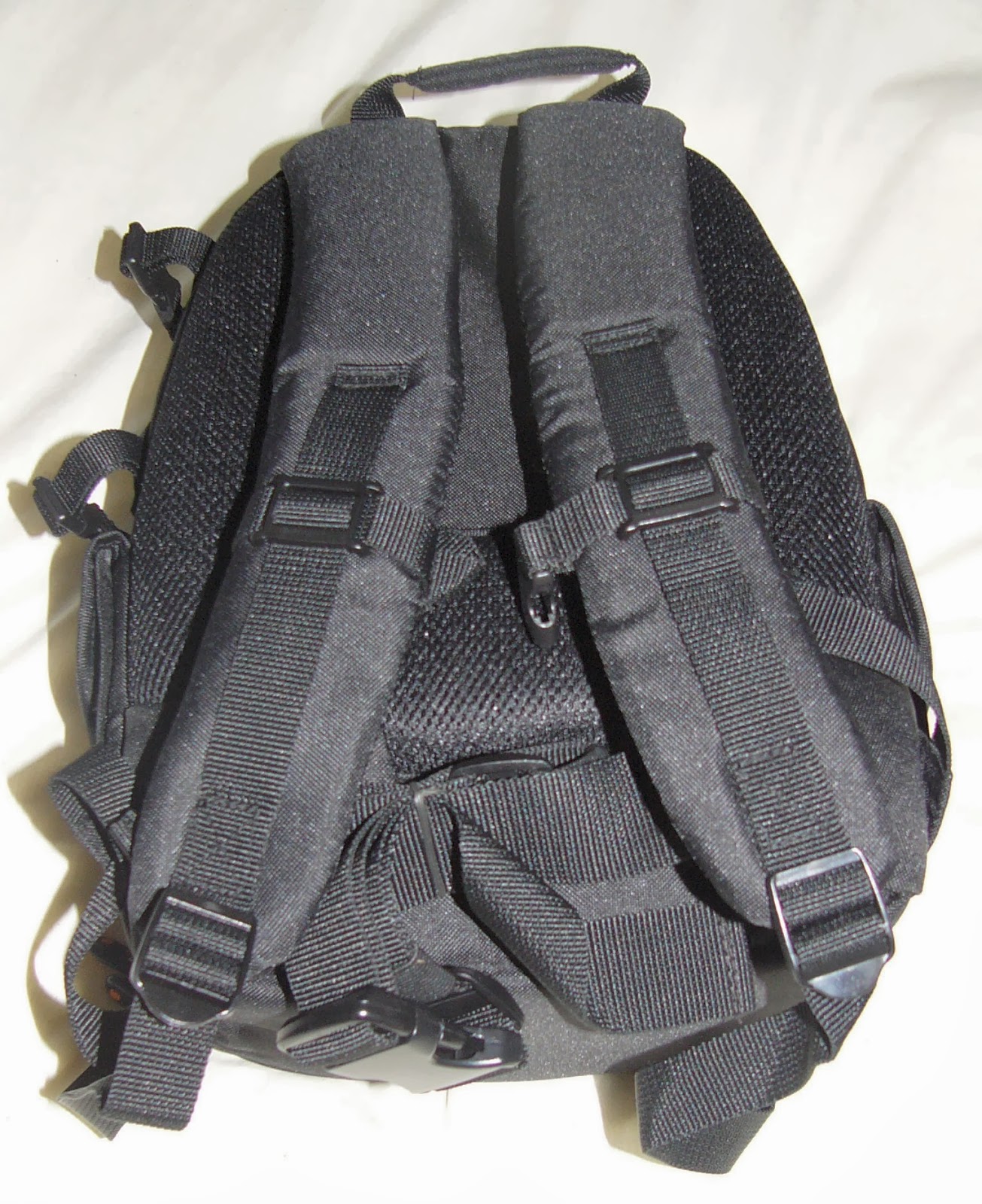
REVIEW: Amazon 'Basics' backpack for SLR cameras

I've always had a hankering for one of these backpack-style camera bags, but have been put off by the outrageous price of those on offer by the 'big name' accessory manufacturers.

This problem has disappeared recently, since Amazon released a selection of gear bags under their generic “Basics” label. This one is the medium-sized version retailing at STG £21.49 incl VAT and free delivery which - in this case – was ordered on Thursday evening and arrived first thing Monday morning.

Predictably enough, the bag is made of ballistic nylon and polyester in an unrelieved black both inside and out, apart from some snazzy zip-pulls with Amazon logos in orange. This anonymity is one of the product's big (but unadvertised) selling points: The conspicuous branding of bags by the likes of Canon, Nikon, Lowepro or Hama is the equivalent of attaching a sign that says “Please steal this bag, it has lots of expensive stuff in it.”

There is no indication as to country of manufacture. (That'll be China, then.) The stitching and other assembly is of good quality, though not outstanding, and the weight (empty) is commendably light at just a tad over 800g.

Inside is a single main compartment measuring 360 x 300 x 135 mm. This is enough space for two SLR camera bodies and a selection of lenses. The central portion will carry a camera with 300mm lens in situ – something my present everyday carry bag won't accommodate. Velcro dividers enable the layout to be tailored as you need it – in my arrangement, I was able to fit my 20x60 spotting scope in there as well. The interior is lined but the zips have no protection, so this backpack would be showerproof but probably not fully waterproof without a rain cover.

Inside the lid are two zipped pockets, also lined, with - joy of joys - transparent facings so that small items can be easily located within them. Lowepro take note. Exterior to the lid are two more divisions: the inner one is not quite deep enough for a laptop but an iPad or similar-sized tablet would certainly fit, perhaps with a bit of extra foam padding for peace of mind. There are two side pockets (with flaps) for odds and ends, and straps on one side that might secure a tripod - if it was a small and light one.

The rigging is good: ventilated mesh at back and padded shoulder straps. A narrow strap with Fastex clip is attached to these but its purpose is not entirely clear: it is too short to be used as a chest strap unless your chest is a lot smaller than mine. 

Further down, I was pleased to find hip pads and a nice broad waist strap – useful for belt-carrying of binoculars, GPS pouch or other accessories which would then stay with the bag when taken off.

All in all, the “Amazon Basics backpack for SLR Cameras” does (almost) everything that its pricier competitors will do – and for far less cash up front. Good value, but not for heavy use in the Amazon. (Or any other rainforest.)

Wednesday, 20 November 2013

THE CURIOUS CASE OF CAPTAIN LIZ


Some things are easier than others. Getting your local Renault dealer to only charge for servicing work that they've actually done is quite easy. Climbing Mount Everest is fairly easy.

Telling one of the world's most eminent ornithologists that he has made a series of mistakes in his data analysis is far from easy. Fortunately, Rob Bierregaard was very good about this, and we have been able to sort out the known facts of this rather sad story, and draw certain conclusions from it all.

Osprey Cap'n Liz left her natal area at Cape Cod on the 8th of October. As many juvenile ospreys do, she headed directly south, over the ocean and down the eastern seaboard of the USA. With the wind in her favour, the little bird made excellent progress – no doubt thinking that this whole migration deal was a piece of cake and that far too much was being made of it. Rather than turn west to make a landfall in the Carolinas, Liz continued on her southward track, at which point things started to go wrong...

The winds that had been helping her died down to almost flat calm for three days – an unusual bit of weather for that area at that time of year. Suddenly, Liz found that maintaining speed was much harder work than it had been. More wing-flapping was needed and she was using up her “fuel” reserves at an alarming rate. By the evening of the 10th, with no change in the conditions, Liz would have been almost exhausted. She even tried to retrace her course, turning back north, but by that time it was far, far too late. 

Thirty nautical miles away, the oceanographic vessel Atlantic Explorer was steering ENE towards her home port in Bermuda. Some days earlier, an osprey had landed on the ship and had kept company with her for a while. Rob Bierregarrd's team thought that this bird MUST be Cap'n Liz.

It wasn't. My analysis of the ship's daily positions shows that Liz never came to Atlantic Explorer, although at one point they were only twenty miles apart. Flying northwards in the darkness, Liz would not have seen the ship and their courses diverged rapidly. What happened next is a matter of some speculation: at 13:00 hrs on the 11th, Liz came down to sea level and her speed dropped almost to zero. She could not fly any further.


It seems certain that Liz had landed on some kind of floating item, although of course we don't know what this was. To the science team back in New Hampshire, the GPS track looked like the course of some powered vessel but it wasn't. I was able to demonstrate that ocean currents and tides would produce the same pattern effect, all on their own.

The PTT tracker continued to transmit but, stranded alone on her raft – whatever it was – exposed to a blazing sun and with no source of fresh water, Liz would not have survived for very long. Dehydration is lethal to birds, almost every time.

Liz was unlucky. Many other juvenile birds – not just ospreys – take this trans-ocean route to the Carribbean and Central America and the vast majority of them survive the attempt. Taking this path saves both time and energy, provided that the wind and weather do not turn against them. To us, this seems like gratuitous risk-taking but that's what birds do.


And they always will.

---------------------------------------------------------------------------------------------

Additional edit: 20 Nov 2013...

There is an intriguing postscript to this story which came to my notice after the above article had been finished.  Of course we don't know what it was that the osprey was cast away on during her final days, but there are more things floating about in the the empty corners of the ocean than coconuts...

Wolfhound adrift in April 2012. (Charles Page)
In February 2013, the Irish-registered 48ft sailing sloop Wolfhound was abandoned by her crew to the west of Bermuda after she got into difficulties during an offshore race.  All personnel were rescued, but Wolfhound continued to drift around the area.  She was seen in April by a passing vessel and found again in July by Matt Rutherford and Nikki Trenholm on their schooner Ault. Rutherford attempted to take Wolfhound in tow but, after an almost-unbelieveable series of misadventures that are detailed HERE, was forced to give up and cast her adrift again.

As far as anyone knows, the yacht Wolfhound is still adrift somewhere in the same area that "Cap'n Liz" was lost.  Could it be...?  We may never know.


Sunday, 29 September 2013

Home for the Winter


 I'm only human. I can easily become enamoured of pretty things, new things, unexpected or wonderful things - Ospreys and eagles and all the endless variety of birds. But first love endures, and these are mine...

The brent geese of Strangford Lough are back.


This morning I was up and out at stupid o'clock, driving the 20-odd miles to an isolated parking spot near the market town of Comber. It was still almost dark, and autumnly cold. A chill east wind whipped in off the slate-grey water, bating the full tide. Not a bird to be seen, on it or by it - they have more sense. But this is Northern Ireland – if you don't like the weather, wait fifteen minutes.

In fact it took twenty for the daily miracle to happen: the sun rose over Greyabbey – well named the place, so it is – and with that a flurry of charcoal wings, low and fast out of the indistinct horizon, and that unforgettable sound...


Of all geese, the brents have the sweetest voices. The new arrivals call to those already paddling in from their hidden roosts back in the saltmarsh. Together they merge into rafts of birds, stem-to-stern and head-to-wind. Last week there were a few hundreds. Today there are thousands.


I've already got my camera coupled to a Televue Ranger 90mm astro refractor. I hate using it for this – focusing is a nightmare, there's no depth of field worth talking about, and the whole set-up is optically snail-like at f8 on a good day – but nothing else in my kit will reach out the 500m to where the geese are starting to feed.

The species is Branta bernicla “hrota” - the pale-bellied race that breeds in the high Canadian Arctic, further north than any other of its kind. They have migrated almost 3000 miles by way of Greenland and then Iceland to spend the winter here in Ulster. It's estimated that 95% of the entire population returns to Strangford and Lough Foyle – a conservation challenge of epic proportions, for the dwarf eel-grass zostera noltii that they prefer grows almost nowhere else in any quantity, except - happy coincidence - the estuary of Afon Dyfi in Wales.

The tide is racing out now, exposing more than 40 hectares of mud flats. The geese follow it and so must I, round the shoreline to Castle Espie WWT where there are higher viewing points – and also hot coffee to be had. The mug goes down well and there's a chance to chat with the staff.

 What's the overall count on the Lough?

22,700 brent geese as of Friday – a good total with the peak month of October not yet reached. It looks like the birds have had a productive breeding season, unlike last year when numbers were down on average.

A few more shots from the shore hide. Curlew are in massed ranks at the edge of the saltmarsh, waiting for their particular cafeteria to open. A leavening of shelduck and wigeon have joined the geese, taking advantage of their vigilance. The sun is almost overhead now and it could even be called warm (with a little imagination).

Sunday afternoon visitors are pouring into the WWT centre, whooping and hollering, and I take the long route round the south perimeter of the reserve to avoid them, pausing only to wince at the recently-completed “Limekiln Observatory”: a well-intentioned but horribly misguided design that merges with the shoreline landscape like a fart in a diving suit.

But not even duff architecture can spoil this day: the geese are back and that's all that matters.


Links:

Ulster Wildlife Trust - Strangford Lough Campaign

Irish Brent Goose Research Group (Site)

Wildfowl & Wetlands Trust - Castle Espie